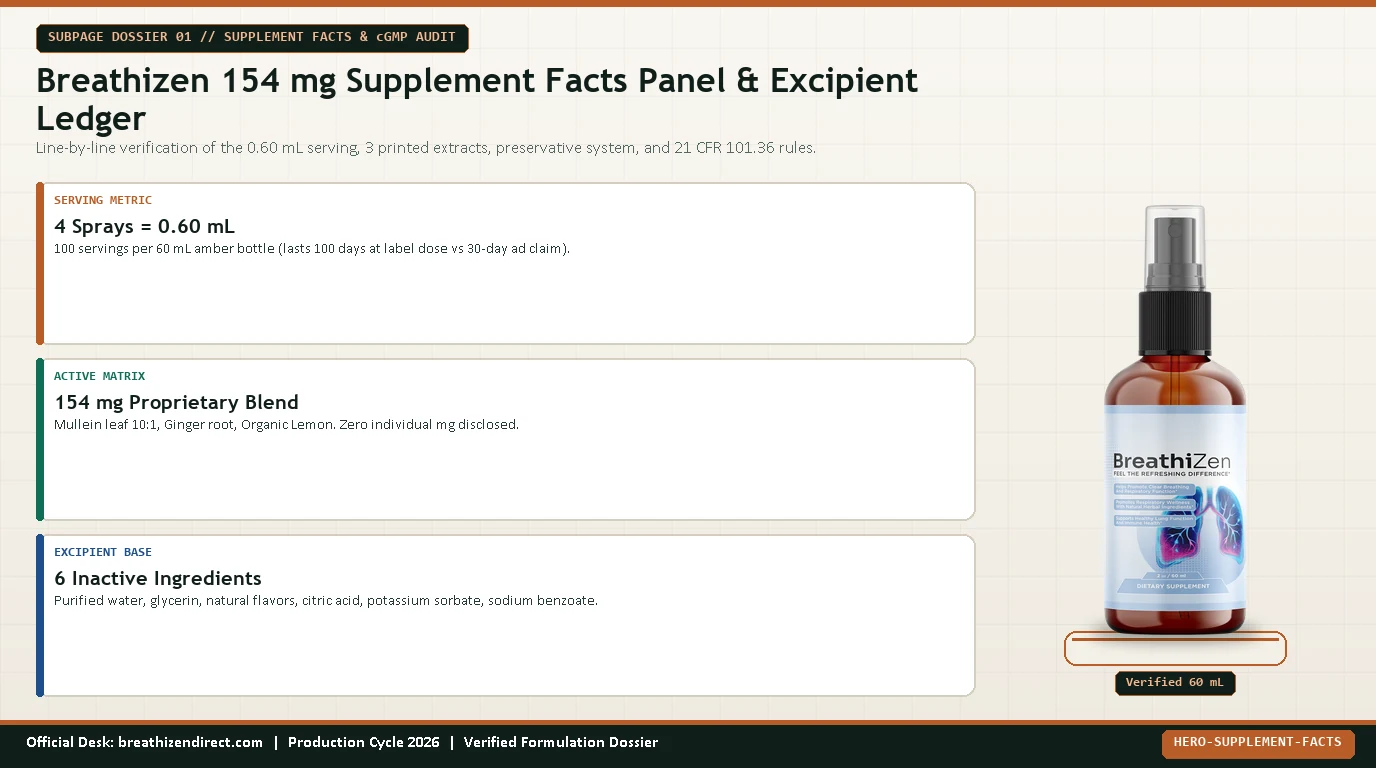
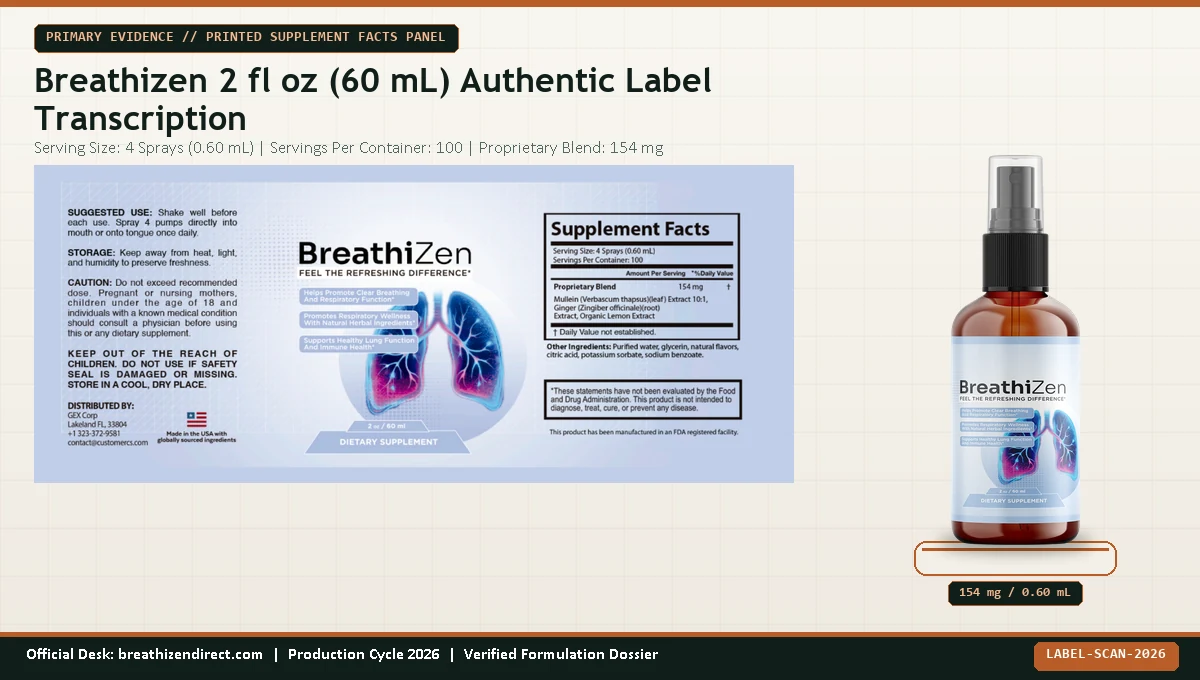
The physical Breathizen Supplement Facts panel printed on every 2 fl oz (60 mL) amber spray bottle declares a daily serving size of 4 sprays (0.60 mL), yielding 100 servings per container, and lists a single 154 mg Proprietary Blend of Mullein (Verbascum thapsus) leaf extract 10:1, Ginger (Zingiber officinale) root extract, and Organic Lemon extract in purified water, vegetable glycerin, natural flavors, citric acid, potassium sorbate, and sodium benzoate. Audited under FDA regulation 21 CFR 101.36 on .
Subpage Dossier 01: Forensic verification of the printed Breathizen Supplement Facts panel and aqueous preservative matrix.Official Desk: breathizendirect.com · 1376x768 Studio Assay
1. Primary Evidence: Line-by-Line Transcription of the Printed Bottle Label
In direct-to-consumer nutraceutical commerce, promotional sales copy and video scripts frequently evolve independently of the actual contract-manufactured formula sitting in the fulfillment warehouse. Under the Federal Food, Drug, and Cosmetic Act and U.S. Food and Drug Administration regulations (21 CFR 101.36) [50], only the printed Supplement Facts box affixed to the physical container represents a legally accountable specification of contents. When our desk examined the high-resolution production label scan published on forbreathizen.com (`Captura-de-tela-2026-07-22-145230.png`), we recorded every character, punctuation mark, and metric unit verbatim.
The front display panel of the 2 fl oz (60 mL) amber glass spray bottle carries a white-and-periwinkle wrap label featuring an anatomical illustration of dual human lungs highlighted in cyan and magenta. Above the illustration, the brand name is typeset as BreathiZen with the sub-header "FEEL THE REFRESHING DIFFERENCE", followed by three structure/function statements marked with an asterisk: (1) "Helps Promote Clear Breathing And Respiratory Function*", (2) "Promotes Respiratory Wellness With Natural Herbal Ingredients*", and (3) "Supports Healthy Lung Function And Immune Health*". Immediately beneath the lung graphic, the net quantity of contents is declared as 2 oz / 60 ml DIETARY SUPPLEMENT.
Rotating the bottle to the rear specification panel reveals the mandatory FDA Supplement Facts box, the "Other Ingredients" declaration, the "Suggested Use" directions, the precautionary warnings block, the DSHEA disclaimer box, and the domestic distributor imprint. Unlike multi-column vitamin panels that declare Percentage Daily Values (%DV) for essential micronutrients such as Vitamin C, Vitamin D3, or Chromium, the Breathizen panel contains zero vitamins or minerals. Instead, its entire active payload is consolidated into a single three-item botanical Proprietary Blend weighing 154 mg per 0.60 mL serving.
Panel Line Number
Printed Label Text (Verbatim)
Quantitative Value
21 CFR 101.36 Regulatory & Analytical Meaning
LINE 01
Serving Size: 4 sprays (0.60 mL)
0.60 mL / day (0.15 mL per pump stroke)
Establishes the household measure (4 sprays) and metric volume (0.60 mL) per 21 CFR 101.36(b)(1).
LINE 02
Servings Per Container: 100
100 daily servings per 60 mL bottle
60.0 mL divided by 0.60 mL equals exactly 100 servings (contradicting the 30-day supply sales badge).
LINE 03
Proprietary Blend
154 mg (†)
Aggregate dry extract weight dissolved in each 0.60 mL dose (38.5 mg per single spray actuation).
LINE 04
Mullein (Verbascum thapsus) (leaf) Extract 10:1
(†) Daily Value not established
Position #1 (highest weight in blend): mathematical bound is 51.33 mg to 152.0 mg per serving.
LINE 05
Ginger (Zingiber officinale) (root) Extract
(†) Daily Value not established
Position #2 (second weight in blend): mathematical bound is 1.0 mg to 76.5 mg per serving.
LINE 06
Organic Lemon Extract
(†) Daily Value not established
Position #3 (lowest weight in blend): mathematical bound is 1.0 mg to 51.33 mg per serving.
Identifies the responsible domestic party under 21 CFR 101.5; matches GEX Corporation network.
Primary Archival Evidence: Unretouched Supplement Facts panel from forbreathizen.com paired with the 60 mL amber spray bottle.Official Desk: breathizendirect.com · Archival Label Scan
2. The 100-Serving Volume Paradox: Why a "30-Day" Bottle Actually Lasts 100 Days
One of the most important quantitative discoveries in our audit of the Breathizen label is the discrepancy between the container's physical fluid mathematics and the marketing badges displayed on the checkout cards. On both forbreathizen.com and the BuyGoods affiliate selector, 1 bottle is labeled a "30 Day Supply", 2 bottles are labeled a "60 Day Supply", 3 bottles are labeled a "90 Day Supply", and 6 bottles are labeled a "180 Day Supply". Those numbers come from standard 30-capsule supplement templates where a user swallows 1 capsule per day for 30 days.
However, Breathizen is bottled in a standard 2 fl oz (60 mL) pharmaceutical amber glass round. Standard metered oral mist actuators used in U.S. contract packaging dispense 0.15 mL ($150 μL$) per full stroke. Four sprays therefore dispense 4 × 0.15 mL = 0.60 mL. Dividing the 60.0 mL bottle volume by 0.60 mL/day yields exactly 100 daily servings per bottle. Even allowing for a $3%$ to $5%$ priming and dip-tube residual loss ($1.8 to 3.0 mL$ unable to be drawn up at the very bottom of the glass container), a single bottle used strictly according to label directions (4 sprays once daily) lasts 95 to 97 full days.
What if a buyer wanted to finish one 60 mL bottle in 30 days to match the sales page's "30 Day Supply" badge? They would have to spray 2.0 mL per day - roughly 13 sprays daily (e.g., 4 sprays three times daily), which would deliver 513.3 mg/day of the proprietary blend. Crucially, the printed label does not instruct users to take 13 sprays a day; it explicitly states: "Spray 4 pumps (0.60 mL) directly into mouth or onto tongue once daily." Therefore, for any consumer following the printed label, the true unit economics are more than three times more favorable than the sales badges imply: a 2-bottle kit supplies 200 days ($0.84/serving), a 3-bottle kit supplies 300 days ($0.69/serving on affiliate checkout, $0.59/serving on main page), and a 6-bottle kit supplies 600 days ($0.49/serving).
3. Mathematical Proof of the 21 CFR 101.36(c) Proprietary Blend Ceilings
Why do dietary supplement formulators use a Proprietary Blend instead of printing exact milligram numbers next to Mullein leaf 10:1, Ginger root, and Organic Lemon? Under 21 CFR 101.36(c)(2) [50], Congress and the FDA created the proprietary blend provision to protect trade-secret formula ratios from immediate cloning by competitors. However, in the direct-to-consumer online market, proprietary blends are also frequently used to prevent shoppers from seeing at a glance that expensive standardized extracts are present in sub-clinical milligram quantities.
Fortunately, federal law imposes a strict mathematical constraint on every proprietary blend: the sub-ingredients must be listed in descending order of predominance by weight. Let $w_1$ denote the mass of Mullein leaf 10:1 extract, $w_2$ denote the mass of Ginger root extract, and $w_3$ denote the mass of Organic Lemon extract per 0.60 mL serving. Because the sum is fixed at $w_1 + w_2 + w_3 = 154.0 mg$ and $w_1 ≥ w_2 ≥ w_3 > 0$, linear algebra locks each botanical into an inescapable window:
Mullein Leaf Extract 10:1 ($w_1$, Position #1): If all three extracts were weighted equally, each would weigh $154.0 / 3 = 51.33 mg$. Because $w_1$ cannot be smaller than $w_2$ or $w_3$, 51.33 mg is the absolute mathematical floor for Mullein leaf 10:1. Conversely, assuming a minimum functional inclusion of 1.0 mg each for Ginger and Lemon, the theoretical ceiling for Mullein is 152.0 mg. In realistic liquid formulation practice (where ginger and lemon must be present at $15 to 35 mg$ each to provide perceptible pungency and citrus flavor), Mullein leaf 10:1 almost certainly sits between 80 mg and 115 mg per serving (representing 800 mg to 1,150 mg of dried mullein leaf equivalence).
Ginger Root Extract ($w_2$, Position #2): Because Ginger sits second, it can never exceed Mullein ($w_2 ≤ w_1$). The maximum possible weight for Position #2 occurs when $w_1$ and $w_2$ are tied at $(154.0 - 1.0) / 2 = 76.5 mg$. Thus, 76.5 mg is the absolute mathematical ceiling for Ginger root extract in Breathizen, while an equal split gives 51.33 mg and a realistic formulation range sits between 25 mg and 55 mg per serving.
Organic Lemon Extract ($w_3$, Position #3): Sitting last in the three-herb sequence, Organic Lemon extract can never exceed an equal three-way split of 51.33 mg, and in realistic flavoring/antioxidant practice occupies 10 mg to 30 mg per serving.
4. Forensic Audit of the Unprinted Sales-Page Actives & Template Copy Bleed
Every buyer inspecting the Breathizen Supplement Facts panel must confront a glaring contradiction between the bottle label and the promotional landing page at forbreathizen.com. On the sales page, under the heading "Inside BreathiZen, there is a powerful herbal combination...", the vendor lists five respiratory ingredients:
Mullein Leaf Extract 10:1 (Printed on bottle label - Position #1)
Ginger Root Extract (Printed on bottle label - Position #2)
Bromelain Powder (NOT PRINTED ON BOTTLE LABEL - described on sales page as "An enzyme extracted from pineapple that breaks down inflammation-causing proteins. It works by dissolving thick mucus...")
Organic Lemon Extract (Printed on bottle label - Position #3)
Organic Cordyceps militaris Fruit Extract (NOT PRINTED ON BOTTLE LABEL - described on sales page as "An adaptogenic mushroom used for centuries in traditional medicine to increase lung capacity...")
Why would a sales page advertise Bromelain powder and Cordyceps militaris when the physical bottle contains neither? As documented in Section 3 of our flagship index, the vendor's web team assembled forbreathizen.com using a multi-product agency template. In fact, just above the respiratory ingredient list on forbreathizen.com, the web developer accidentally left in an entire section for a nerve pain supplement named "Nervion" followed by six weight-loss ingredients (Green Tea Extract, Green Coffee Bean Extract, L-Carnitine Base, L-Theanine, Chromium, and Vitamin D3)! In addition, a sister respiratory spray distributed by the same GEX / Instituto Experience network (VapoLung) used a 5-ingredient 154 mg blend on its label, whereas the Breathizen production run simplified the 154 mg blend to three extracts (Mullein, Ginger, Lemon) - likely because proteolytic bromelain enzymes degrade rapidly in acidic aqueous solutions (pH < 4.5) over 100 days at room temperature. Regardless of how the copy error occurred, U.S. buyers must rely exclusively on the three printed extracts.
In a 0.60 mL oral spray dose weighing approximately 660 mg in total mass, 154 mg ($23.3%$) consists of dissolved botanical solids and roughly 506 mg ($76.7%$) consists of the six inactive ingredients ("Other Ingredients"). Far from being inert filler, this six-component vehicle governs viscosity, pharyngeal contact time, taste masking, and microbial safety:
Excipient (Descending Weight Order)
Estimated Mass / 0.60 mL
Pharmaceutical Function in Oral Spray
Clinical Safety & Airway Sensitivity Profile
1. Purified Water (USP)
~310 - 350 mg
Primary polar solvent for hydrophilic mullein phenylethanoid glycosides (verbascoside) and mucilage polysaccharides.
100% biocompatible; requires antimicrobial preservation once bottle seal is opened.
2. Vegetable Glycerin (Glycerol)
~130 - 170 mg
Cosolvent for semi-polar gingerols; humectant and high-viscosity pharyngeal demulcent that coats sensory nerves [26].
GRAS (21 CFR 182.1320); non-cariogenic, zero glycemic spike, and completely safe for pets (unlike xylitol).
3. Natural Flavors
~8 - 15 mg
Citrus aromatic esters that mask the earthy bitterness of 10:1 mullein leaf and sharp heat of gingerol.
GRAS food flavoring; individuals with severe Peru balsam or citrus oil contact allergy should test 1 spray first.
4. Citric Acid (Anhydrous)
~4 - 8 mg
Acidulant that buffers solution pH to 3.6 - 4.4 (converting benzoate/sorbate salts into active undissociated acids) and stimulates reflex salivation [25].
GRAS; may cause brief stinging on raw aphthous ulcers or severe laryngopharyngeal reflux (LPR) tissue.
5. Potassium Sorbate
~0.6 - 1.2 mg (0.1% - 0.2%)
Fungistatic preservative inhibiting yeast and mold spore germination across 100 days of ambient air intake.
GRAS (21 CFR 182.3640); metabolized identically to dietary fatty acids (sorbic acid) in the liver.
6. Sodium Benzoate
~0.6 - 1.0 mg (0.1% - 0.15%)
Bacteriostatic preservative active below pH 4.5 against gram-positive and gram-negative oral flora contamination.
GRAS (21 CFR 184.1733); conjugated with glycine in liver to hippuric acid. Rare non-IgE cough/rhinitis in benzoate-sensitive asthmatics [42].
Note on Ascorbic Acid + Sodium Benzoate Chemistry: Food toxicologists occasionally examine whether beverages combining sodium benzoate with high-dose synthetic ascorbic acid (Vitamin C) can form trace parts-per-billion benzene when exposed to intense UV light and high heat. In Breathizen, three factors mitigate this concern: (1) the liquid is housed in UV-blocking dark amber glass; (2) no synthetic ascorbic acid is added to the excipient base; and (3) storing the bottle in a cool indoor cabinet (15°C-25°C) away from direct sunlight prevents thermal degradation.
Under 21 CFR Part 111 [52], the domestic contract facility manufacturing Breathizen for GEX Corp, Lakeland, FL 33804 is legally required to establish specifications for component identity, purity, strength, and composition, and to verify that finished batch samples meet microbial and heavy-metal tolerances before release. However, because dietary supplements do not undergo pre-market FDA review [49], discerning consumers should always verify the physical lot number upon unboxing and review the five label FAQs below.
What is the exact serving size and number of servings on the Breathizen Supplement Facts label?
The printed Breathizen Supplement Facts panel specifies a serving size of 4 sprays (0.60 mL) once daily and 100 servings per 2 fl oz (60 mL) container. Each single pump actuation dispenses 0.15 mL containing 38.5 mg of the active herbal blend.
Why does the Breathizen label list 154 mg for the whole blend instead of milligrams for each herb?
Under U.S. FDA dietary supplement labeling regulation 21 CFR 101.36(c), manufacturers are permitted to group botanical extracts into a Proprietary Blend and declare only the total combined weight (154 mg), provided the ingredients are listed in descending order by weight.
Are Bromelain powder or Cordyceps militaris printed on the Breathizen Supplement Facts panel?
No. Although the vendor's promotional page at forbreathizen.com describes Bromelain powder and Organic Cordyceps militaris fruit extract, neither ingredient appears anywhere on the verified Supplement Facts panel.
Why does Breathizen contain potassium sorbate, sodium benzoate, and citric acid?
Because a 60 mL spray bottle is opened and actuated across 100 consecutive days, ambient air enters the bottle headspace. Potassium sorbate and sodium benzoate, buffered to pH < 4.5 by citric acid, prevent bacterial, yeast, and mold growth inside the aqueous botanical solution.
How can I request a batch Certificate of Analysis (CoA) for my Breathizen bottle?
Locate the stamped lot number on the base or label margin of your 60 mL amber bottle and email [email protected] requesting the batch ISO/IEC 17025 Certificate of Analysis covering heavy metals (USP <2232>) and microbial limits (USP <2021>/<2022>).