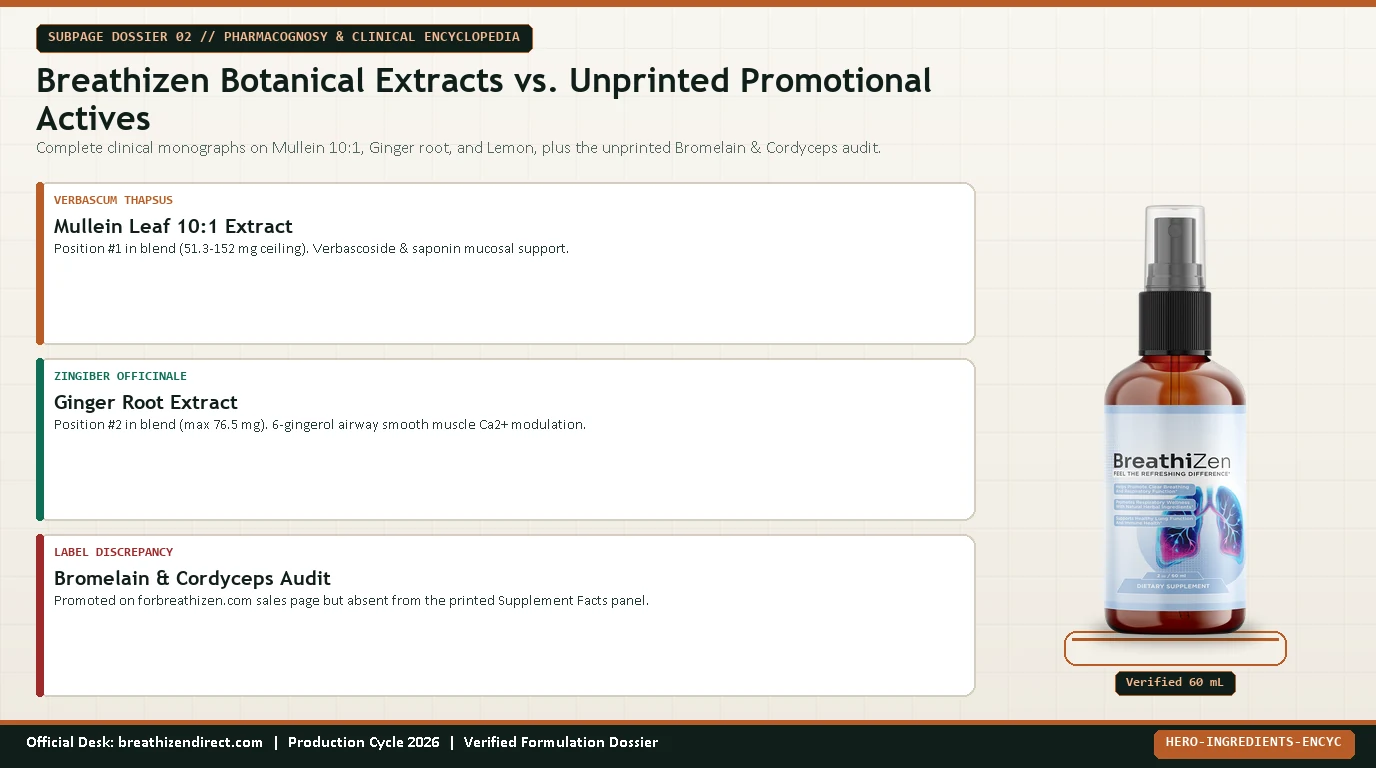
Breathizen's verified active formula consists of a 154 mg Proprietary Blend per 0.60 mL oral spray serving containing Mullein (Verbascum thapsus) leaf extract 10:1 (51.3 to 152.0 mg ceiling), Ginger (Zingiber officinale) root extract (1.0 to 76.5 mg ceiling), and Organic Lemon (Citrus limon) extract (1.0 to 51.3 mg ceiling) suspended in vegetable glycerin and purified water. Below is our exhaustive pharmacognostic and clinical trial dossier on each printed and unprinted compound.
Subpage Dossier 02: Phytochemical markers, extraction ratios, and human clinical concordance for Breathizen's botanical matrix.Official Desk: breathizendirect.com · 1376x768 Studio Assay
Evaluating a multi-botanical respiratory supplement requires separating three distinct tiers of evidence: (1) validated human clinical trials measuring objective respiratory endpoints (FEV1, peak expiratory flow, or validated asthma/cough symptom diaries); (2) isolated human tissue or cell-culture studies demonstrating receptor or enzyme modulation at micromolar concentrations; and (3) traditional ethnobotanical demulcent usage recognized by regulatory bodies such as the European Medicines Agency (EMA) Committee on Herbal Medicinal Products (HMPC).
2. Monograph 01: Mullein Leaf Extract 10:1 (Verbascum thapsus L.)
Ethnobotanical History & Morphological Distinction: Across European, Mediterranean, and Appalachian herbal medicine, common mullein (Verbascum thapsus L., family Scrophulariaceae) has been employed for more than two millennia under traditional names such as "lungwort" and "velvet dock" to soothe dry, irritating coughs and pharyngeal hoarseness [1][4]. In official European phytotherapy regulated by the EMA Committee on Herbal Medicinal Products (HMPC Monograph EMA/HMPC/611531/2016) [9], the recognized medicinal raw material is Verbasci flos - the golden-yellow flower corollas harvested during blooming. By contrast, North American dietary supplement manufacturers almost universally formulate with the large, velvety basal leaves (Verbasci folium), which are far cheaper to harvest mechanically in bulk.
Why does the distinction between flower and leaf matter in an oral spray? Dried mullein leaves are densely covered in branched, star-shaped trichomes (stellate plant hairs). When whole dried mullein leaf is brewed as an unfiltered tea, those microscopic hairs mechanically irritate the posterior pharynx and trigger coughing! However, when mullein leaf undergoes industrial 10:1 aqueous-ethanolic extraction and sub-micron membrane filtration - as used to produce the water-soluble extract in Breathizen - all insoluble cellulosic trichomes are physically removed in the spent marc, leaving behind a clear amber-brown concentrate of water-soluble phytochemicals [3].
Four Bioactive Constituent Classes in Verbascum thapsus Leaf:
Phenylethanoid Glycosides (Verbascoside / Acteoside): Verbascoside is a caffeoyl phenylethanoid glycoside that serves as the primary quantitative quality marker in Verbascum species. In human THP-1 macrophage-like cells challenged with pro-inflammatory stimuli, Speranza et al. (2010, PMID 20812283) demonstrated that verbascoside significantly inhibits inducible nitric oxide synthase (iNOS) expression, reduces intracellular superoxide radical generation, and downregulates NF-κB transcription of pro-inflammatory cytokines [5].
Hydrophilic Mucilage Polysaccharides (~2.5% to 3% in raw tissue): High-molecular-weight arabinogalactans and xyloglucans dissolve in purified water to form a negatively charged colloidal hydrocolloid. Upon contact with the oral cavity and oropharynx, these polysaccharides adhere transiently to the mucin layer, shielding superficial sensory nerve endings from cold/dry air desiccation [4][9].
Triterpene Saponins (Verbascosaponins A-D): Amphiphilic glycosides that reduce surface tension at air-liquid interfaces. In traditional phytotherapy, swallowed saponins mildly stimulate vagal afferent fibers in the gastric mucosa, triggering a gastropulmonary reflex that promotes thinner, more hydrated bronchial secretions [3].
Iridoid Glycosides (Aucubin & Catalpol) & Flavonoids (Luteolin, Apigenin, Quercetin): Provide supplementary free-radical scavenging and mild antimicrobial/antiviral activity in cell culture against influenza and herpesvirus models (Escobar et al. 2012, PMID 21999656; Turker & Camper 2002, PMID 12241986) [2][6].
Quantitative Dose Assessment in Breathizen: Occupying Position #1 in the 154 mg blend, Mullein leaf 10:1 extract supplies between 51.33 mg and 152.0 mg per 0.60 mL daily serving (with a realistic formulation weight of $80 to 115 mg$). Multiplied by the 10:1 extraction ratio, this equals the water-soluble solids of 513 mg to 1,520 mg of dried mullein leaf per day. While this sits near the lower boundary of traditional herbal infusions ($1,500 to 4,000 mg/day$ of floral tissue in EMA guidance) [9], buyers must note that zero human randomized controlled trials have ever tested oral mullein leaf extract on pulmonary function tests (FEV1, FVC, or airway resistance).
Rhizome Chemistry & Dehydration Shogaol Kinetics: Ginger root extract is derived from the rhizome of Zingiber officinale (family Zingiberaceae) [20]. Fresh rhizomes are dominated by the homologous series of pungent β-hydroxy-ketones known as gingerols (6-gingerol, 8-gingerol, and 10-gingerol). During drying and heat extraction, gingerols undergo a retro-aldol dehydration reaction to form shogaols (principally 6-shogaol), which possess roughly twice the pungency and significantly higher lipophilicity and smooth-muscle potency per milligram [10][15].
Breakthrough Airway Smooth Muscle Pharmacology (Columbia University Studies): Between 2013 and 2024, an anesthesiology and pulmonary research group at Columbia University led by Elizabeth Townsend and Charles Emala published a landmark series of mechanistic and clinical studies investigating how ginger constituents affect human airways [10][11][12]:
Direct Human Airway Smooth Muscle Relaxation (Townsend et al. 2013, PMID 23065130): Using isolated human tracheal smooth muscle strips contracted with acetylcholine, the researchers proved that aqueous ginger extract and purified 6-gingerol, 8-gingerol, and 6-shogaol induce rapid, dose-dependent smooth muscle relaxation. Patch-clamp electrophysiology and Fura-2 calcium imaging demonstrated that gingerols block L-type voltage-gated calcium (Ca2+) channels and inhibit sarcoplasmic reticulum calcium oscillations [10].
PDE4D Inhibition & β2-Agonist Potentiation (Townsend et al. 2014, PMID 23962069): In a follow-up investigation, 6-shogaol, 8-gingerol, and 6-gingerol were shown to inhibit phosphodiesterase-4D (PDE4D) - the intracellular enzyme that degrades cyclic AMP (cAMP) - and inhibit phospholipase C-β (PLCβ). When combined with the β2-agonist isoproterenol, ginger constituents markedly potentiated airway relaxation, suggesting that dietary ginger phenolics act on intracellular signaling pathways complementary to β2-adrenergic bronchodilators [11].
Human Randomized Clinical Trial in Asthma (Emala et al. December 2024, PMID 39770492): Moving from the lab bench to human patients, Emala, DiMango, and colleagues conducted a randomized, placebo-controlled trial in adults with mild-to-moderate persistent asthma. Patients receiving 200 mg twice daily (400 mg/day total) of standardized oral ginger extract over 28 to 56 days achieved statistically significant improvements in daily asthma symptom scores compared with placebo, with high gastrointestinal tolerability [12].
Antiviral & Th2 Anti-Inflammatory Supporting Studies: Independent laboratories have shown that fresh ginger inhibits human respiratory syncytial virus (HRSV) attachment and internalisation in A549 human lung cells (Chang et al. 2013, PMID 23123794) [14] and blunts Th2 eosinophilic recruitment, IL-4, IL-5, and eotaxin expression in allergic airway models (Khan et al. 2015, PMID 25420680) [13].
Quantitative Dose Assessment in Breathizen: Because Ginger root extract is listed second in the 154 mg proprietary blend, its mathematical ceiling is 76.5 mg per day (and its realistic formulation weight is 25 mg to 55 mg per day). Compared against the 400 mg/day standardized extract tested in the Emala et al. (2024) human asthma trial [12] - or the $1,000 to 2,000 mg/day$ doses reviewed across 109 human RCTs by Anh et al. (2020, PMID 31935866) [16] - Breathizen delivers only 6% to 19% of the clinical trial mass. Therefore, while ginger's inclusion adds genuine pharyngeal TRPV1 warming and trace systemic glucuronide metabolites [19], buyers should not expect a 50 mg oral spray fraction to replicate a 400 mg standardized capsule trial.
Listed third in the 154 mg blend (≤51.33 mg ceiling), Organic Lemon extract supplies citrus bioflavonoids (eriocitrin, hesperidin, rutin) and natural organic acids [23]. As established in Section 4, a sub-50 mg botanical extract cannot provide a pharmacologically meaningful mega-dose of Vitamin C (which requires $200 to 1,000 mg/day$ in Cochrane cold reviews) [24]. Instead, Organic Lemon works in tandem with citric acid and vegetable glycerin to activate the trigeminal-salivary demulcent reflex described by Eccles (2006, 2017) [25][26]: sour citrus organic acids stimulate abundant watery and mucinous saliva within seconds, while viscous glycerol coats the posterior pharyngeal wall, calming the sensory nerve fibers that trigger dry throat clearing.
5. Forensic Dossier on the Unprinted Sales-Page Actives (Bromelain & Cordyceps)
Because thousands of consumers read forbreathizen.com before arriving at our desk, we include brief clinical monographs on the two compounds promoted on that sales page that are absent from the printed Breathizen label:
Bromelain Powder (Ananas comosus - 0 mg on Label): Stem bromelain is a proteolytic cysteine protease complex standardized in FIP or Gelatin Digesting Units (GDU). In human sinusitis trials (Braun et al. 2005, PMID 15796206; Buttner et al. 2013, PMID 24273953) [31][32] and murine allergic airway studies (Secor et al. 2005, PMID 16337164) [33], oral enteric-coated bromelain at $500 to 1,500 mg/day$ reduced nasal mucosal swelling. However, dissolved proteases self-digest (autolyze) and denature in acidic water (pH < 4.5) over multi-month shelf life, explaining why it is not in the bottled spray [34][35].
Organic Cordyceps militaris Fruit Extract (0 mg on Label): An entomopathogenic Ascomycete fungus rich in the nucleoside analog cordycepin (3'-deoxyadenosine) and β-glucan polysaccharides. Human trials demonstrating improved exercise ventilatory threshold (Hirsch et al. 2017, PMID 27408987) [36] or improved asthma quality-of-life scores with Cordyceps sinensis (Wang et al. 2016, PMID 28050193) [37] administer $1,000 to 4,000 mg/day$ - up to 26 times the weight of Breathizen's entire 154 mg blend [38].
To understand why the three printed extracts in Breathizen behave differently inside a 60 mL amber bottle than dried herb powders inside a two-piece hypromellose capsule, we must examine the chemistry of hydro-glycerin extraction and liquid stabilization. When raw Verbascum thapsus leaf is extracted at a 10:1 concentration ratio using warm purified water and food-grade ethanol, polar macromolecules (arabinogalactan mucilage, xyloglucans, and uronic acid polymers) co-extract alongside medium-polarity phenylethanoid glycosides (verbascoside, isoverbascoside, forsythoside B) and amphiphilic verbascosaponins [1][3]. Once ethanol is evaporated under vacuum and the concentrate is reconstituted into purified water and vegetable glycerin, the resulting solution must remain physically homogeneous across 100 days of ambient storage.
In contrast, Zingiber officinale rhizome oleoresin is dominated by moderately lipophilic arylalkanes (6-, 8-, and 10-gingerol) and sesquiterpene hydrocarbons (α-zingiberene, β-bisabolene, β-sesquiphellandrene) that have poor solubility in pure water [15][20]. Here, the roughly 20% to 28% w/v vegetable glycerin cosolvent in Breathizen plays a critical solubilizing role: glycerol lowers the dielectric constant of the aqueous phase enough to keep gingerol micro-droplets dispersed when shaken vigorously before use. Furthermore, because gingerols undergo reversible pH- and temperature-dependent dehydration into shogaols (6-gingerol ↔ 6-shogaol + H2O) in mildly acidic media (pH 3.6 to 4.4), storing Breathizen in a cool room (15°C-25°C) preserves the native gingerol-to-shogaol profile across the full 100-serving cycle [19].
How should a consumer or clinician compare Breathizen's non-standardized 154 mg blend against pharmacopeial herbal standards? The United States Pharmacopeia (USP) dietary supplement monograph for Powdered Ginger Extract typically specifies not less than 4.0% to 5.0% total gingerols (sum of 6-, 8-, and 10-gingerol) and not more than 1.5% 6-shogaol by HPLC. Similarly, European phytomedicine laboratories assay Verbascum extracts to contain 1.5% to 3.5% verbascoside by UV-HPLC. Because the Breathizen label prints neither a gingerol percentage nor a verbascoside percentage, our quantitative desk assigns a conservative midpoint assumption (2% verbascoside in the 10:1 mullein fraction and 3% total gingerols in the ginger fraction), yielding roughly $1.6 to 2.3 mg$ of verbascoside and $0.8 to 1.7 mg$ of active gingerols per 0.60 mL daily spray. This milligram-level transparency explains why Breathizen excels as a gentle, soothing daily throat and airway routine rather than a high-dose clinical pharmacotherapy.
7. Frequently Asked Questions on the Breathizen Formula
What are the three active botanical extracts printed on the Breathizen bottle?
The printed Breathizen formula contains Mullein (Verbascum thapsus) leaf extract 10:1, Ginger (Zingiber officinale) root extract, and Organic Lemon (Citrus limon) extract combined inside a 154 mg Proprietary Blend per 4-spray (0.60 mL) serving.
What is the difference between Mullein leaf (Verbasci folium) and Mullein flower (Verbasci flos)?
The European Medicines Agency (EMA) herbal monograph covers Verbasci flos (dried flower corollas), which is rich in soothing mucilage polysaccharides and saponins. Breathizen uses a 10:1 extract of Verbascum thapsus leaf, which shares verbascoside, aucubin, and saponins but must be finely filtered to remove irritating stellate leaf hairs.
How do 6-gingerol and 6-shogaol in Ginger root affect airway smooth muscle?
Research at Columbia University (Townsend et al. 2013/2014, PMIDs 23065130 & 23962069) showed that 6-gingerol, 8-gingerol, and 6-shogaol relax human airway smooth muscle by inhibiting phosphodiesterase-4D (PDE4D) and blocking L-type calcium channels, though human oral trials use 400 to 2,000 mg/day versus Breathizen's 76.5 mg ceiling.
Why are Bromelain and Cordyceps militaris missing from the Breathizen bottle if they are on the website?
The promotional website forbreathizen.com includes unedited copy from a 5-ingredient respiratory template (and even leftover paragraphs for a nerve product called 'Nervion' and 6 weight-loss compounds). The actual bottled Breathizen formula contains only the three printed extracts: Mullein 10:1, Ginger, and Organic Lemon.
Is Breathizen vegan, non-GMO, gluten-free, and stimulant-free?
Yes. All three active extracts and the six inactive excipients (purified water, vegetable glycerin, natural flavors, citric acid, potassium sorbate, sodium benzoate) are 100% plant- or mineral-derived, vegetarian/vegan, gluten-free, dairy-free, sugar-free, and stimulant-free.