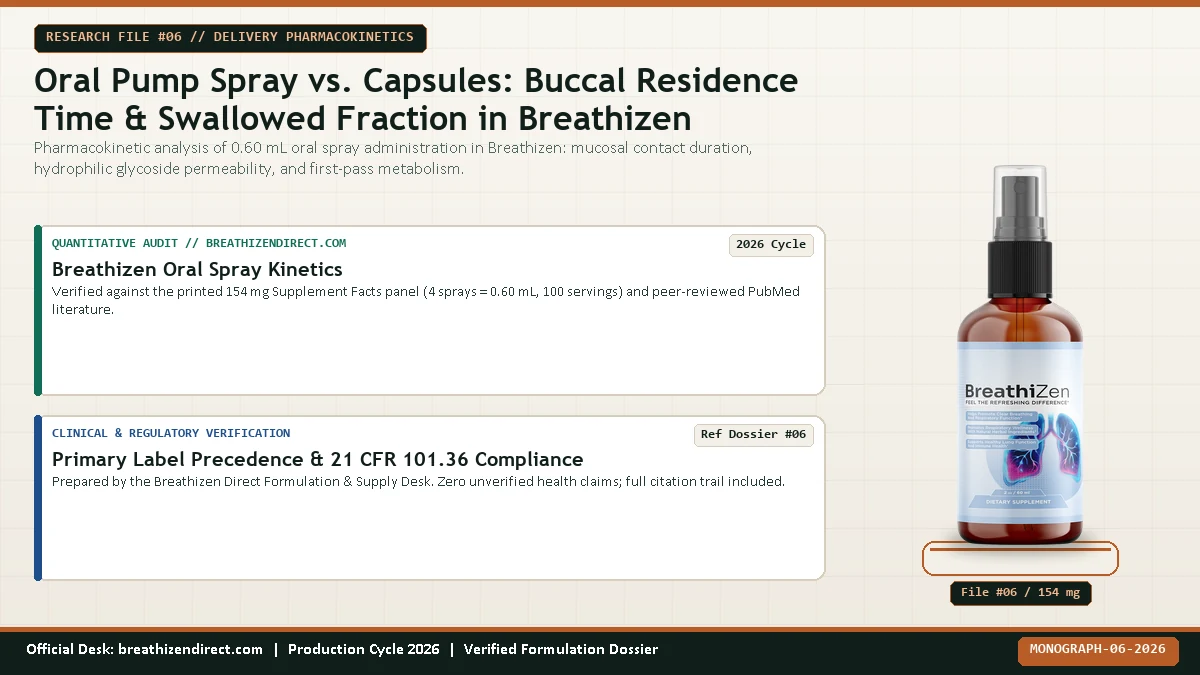
Oral Pump Spray vs. Capsules: Buccal Residence Time & Swallowed Fraction in Breathizen
Promotional copy for liquid oral sprays frequently claims that spraying herbs into the mouth 'bypasses digestion for 98% instant sublingual absorption.' To separate marketing hyperbole from biopharmaceutics, this monograph models the actual oral residence time (20 to 45 seconds), molecular weight and lipophilicity (Log P) partitioning, mucociliary/pharyngeal contact, and swallowed gastrointestinal fraction of Breathizen's 0.60 mL daily spray.
Monograph Dossier #06 (Delivery Pharmacokinetics): Pharmacokinetic analysis of 0.60 mL oral spray administration in Breathizen: mucosal contact duration, glycoside permeability, and swallowed fraction.Official Desk: breathizendirect.com · 1200x675 Widescreen Assay
1. Anatomy of Oral Transmucosal Delivery: Sublingual vs. Buccal vs. Orally Swallowed
In pharmaceutical drug delivery science (Hua 2019, Front Pharmacol PMID 31827435; Patel et al. 2011, J Control Release PMID 21300115) [29][30], administering a 0.60 mL liquid mist into the oral cavity exposes the solution to three distinct anatomical compartments before swallowing:
The Sublingual Mucosa (Floor of the Mouth & Ventral Tongue): Non-keratinized stratified squamous epithelium measuring only 100 to 200 μm thick, richly perfused by reticulated venous capillaries draining directly into the internal jugular vein (bypassing first-pass hepatic portal metabolism). However, the sublingual floor is continuously bathed by saliva from Wharton's and Bartholin's ducts, which rapidly dilutes and washes liquids backward toward the pharynx within 20 to 40 seconds.
The Buccal Mucosa (Inner Cheeks): Non-keratinized epithelium measuring 500 to 800 μm thick (3 to 5 times thicker than the sublingual floor), offering a larger surface area (~50 cm2) and lower enzymatic turnover, but requiring longer mucosal contact time for passive transcellular diffusion.
The Posterior Oropharynx & Esophageal Swallow: Regardless of how carefully a user holds 0.60 mL of spray in the mouth for 25 to 30 seconds, stimulated salivary flow (~1.5 to 3.0 mL/min when triggered by citric acid and lemon extract) mixes with the 0.60 mL dose and triggers a physiological swallow reflex. Consequently, 75% to 90% of the total botanical mass is ultimately swallowed into the stomach and duodenum[29][30].
2. Lipinski's Rule of 5 & Log P Partitioning Across Breathizen's Phytochemicals
Not all plant molecules inside Breathizen's 154 mg blend behave identically when they contact the oral mucosa. Passive transcellular diffusion across the lipid bilayers of sublingual and buccal epithelial cells requires moderate lipophilicity ($Log P$ between $1.5$ and $3.5$) and low molecular weight ($< 500 Da$) [30]:
Moderately Lipophilic Gingerols & Lemon Monoterpenes (Partial Buccal/Sublingual Uptake + Duodenal Absorption): 6-gingerol ($MW = 294.39 g/mol$, $Log P ≈ 2.7$) and 6-shogaol ($MW = 276.37 g/mol$, $Log P ≈ 3.4$), along with citrus monoterpenes ($d$-limonene, citral, $MW ≈ 136-152 g/mol$), possess ideal lipophilicity to partition into buccal and sublingual lipid membranes during a 30-second oral hold, while the swallowed fraction absorbs rapidly across the duodenum ($T_ ≈ 55 min$) [19].
Hydrophilic Glycosides - Verbascoside & Aucubin (Predominantly Swallowed GI Absorption): Verbascoside ($MW = 624.59 g/mol$, $Log P ≈ -0.8$, 9 hydrogen-bond donors) and iridoid glycosides are polar, water-soluble molecules that cross non-keratinized oral mucosa very slowly over a 30-second hold; they act topically on pharyngeal tissues and are absorbed primarily in the small intestine after swallowing [5][30].
Macromolecular Mullein Mucilage Polysaccharides & Glycerol (100% Topical Pharyngeal Coating): High-molecular-weight arabinogalactan polysaccharides ($>50,000 Da$) and vegetable glycerin form a physical bioadhesive hydrogel over the tongue, soft palate, and posterior pharynx. Here, an oral pump spray is genuinely superior to a swallowed gelatin capsule! A swallowed capsule bypasses the throat entirely and dissolves in the stomach, providing 0% topical demulcent relief to dry pharyngeal cough receptors [26].
3. Why You Must Never Inhale an Oral Pump Spray Into the Lungs
Because Breathizen is marketed for respiratory wellness, some buyers mistakenly wonder if they should breathe in while actuating the spray nozzle - just like a metered-dose asthma inhaler (MDI). Never inhale Breathizen into your trachea or lungs. A prescription pulmonary MDI or nebulizer is engineered to generate ultra-fine sterile aerosol particles with a Mass Median Aerodynamic Diameter (MMAD) of 1 to 5 μm capable of navigating bronchial bifurcations down to the alveoli. By contrast, Breathizen's mechanical oral pump generates coarse liquid droplets of 60 to 150 μm containing vegetable glycerin, citric acid, plant extracts, potassium sorbate, and sodium benzoate designed strictly for the oral cavity and digestive tract. Inhaling coarse acidic glycerin droplets into the larynx or trachea will trigger immediate protective coughing and laryngeal spasm.
Does spraying Breathizen under the tongue mean 100% of the herbs absorb sublingually?
No. While lipophilic molecules like 6-gingerol and lemon terpenes partially partition into the sublingual and buccal mucosa during a 30-second hold, roughly 75% to 90% of the 0.60 mL liquid mixes with saliva and is swallowed into the digestive tract.
What is the main advantage of an oral spray over a swallowed mullein-ginger capsule?
The #1 advantage of an oral spray is topical pharyngeal contact: when you swallow a capsule, it bypasses the back of your throat completely. Spraying Breathizen coats the posterior pharynx with vegetable glycerin, lemon organic acids, and mullein mucilage, calming dry throat receptors within seconds.
How long should I hold the 4 sprays in my mouth before swallowing?
Hold the 0.60 mL mist on your tongue and inner cheeks for 25 to 30 seconds before swallowing slowly, and then wait 15 minutes before drinking water, coffee, or tea.
Why must I never inhale the Breathizen spray mist into my lungs?
Breathizen is an oral food-grade dietary supplement containing vegetable glycerin, citric acid, plant extracts, and preservatives dispensed in coarse droplets (60-150 microns). It is not a sterile 1-5 micron pulmonary inhalation solution; inhaling it into the windpipe will cause coughing and irritation.
Why does the bottle need to be shaken for 5 to 8 seconds before spraying?
Concentrated botanical extracts (10:1 mullein leaf and ginger root) suspended in purified water and vegetable glycerin can settle slightly when standing upright. Shaking for 5 to 8 seconds ensures uniform 38.5 mg/spray dispersion.
Related Clinical Monographs in the Breathizen Research Cluster