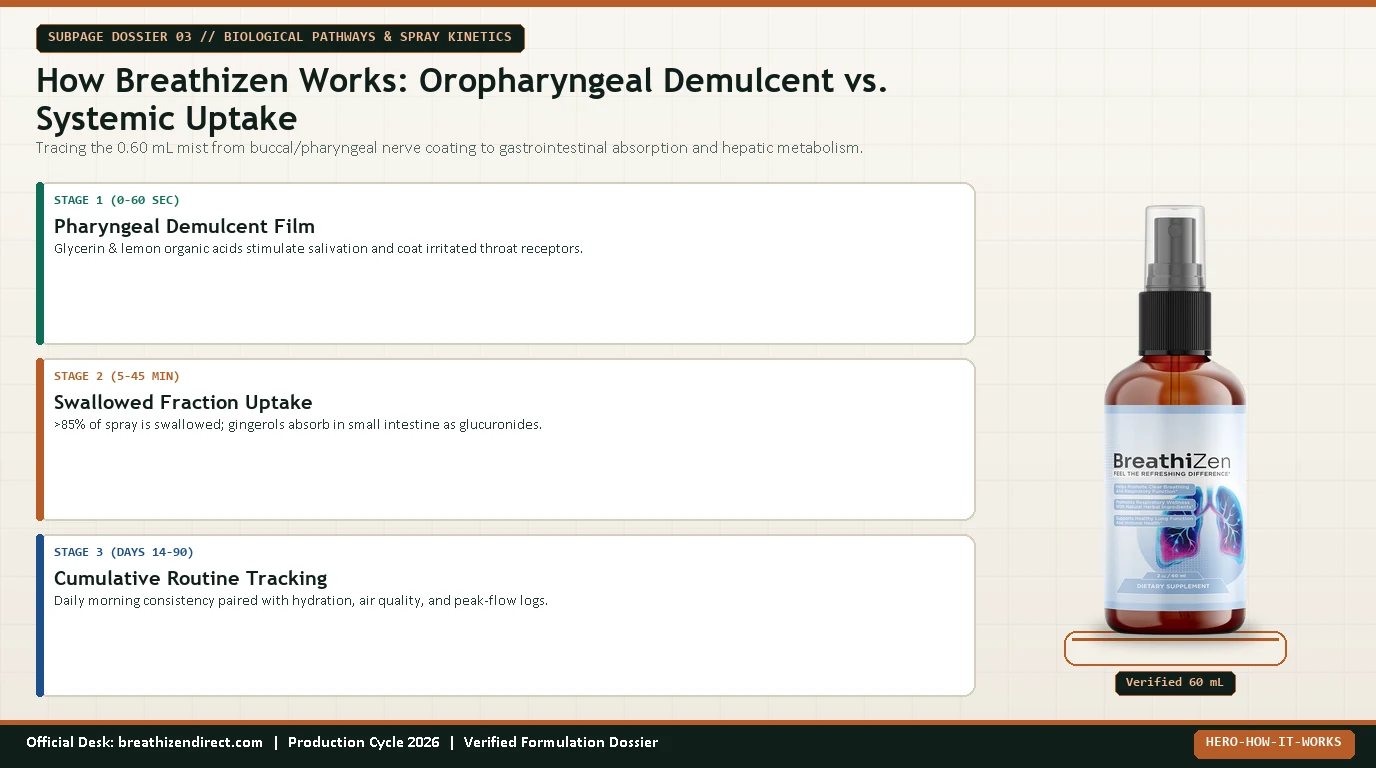
Breathizen operates through a two-stage physiological sequence: first, within 30 to 90 seconds of spraying 0.60 mL onto the tongue, vegetable glycerin, citric acid, and organic lemon extract coat pharyngeal sensory nerve endings and trigger protective salivation; second, after swallowing, ginger root phenolics (6-gingerol and 6-shogaol) and mullein leaf glycosides (verbascoside) undergo intestinal absorption and systemic circulation to offer mild nutritional support for airway comfort.
Subpage Dossier 03: Anatomical and pharmacokinetic trajectory of a 0.60 mL Breathizen oral mist dose from tongue to systemic circulation.Official Desk: breathizendirect.com · 1376x768 Studio Assay
1. Anatomical Trajectory: Why Oral Pump Sprays Deposit in the Oropharynx, Not the Alveoli
Marketing phrases such as "works directly on the lungs and respiratory pathways" on forbreathizen.com can easily mislead lay consumers into imagining that an oral spray travels down the windpipe (trachea) into the bronchial tree. In aerosol physics and pulmonary drug delivery, airway penetration is governed strictly by the mass median aerodynamic diameter (MMAD) of the droplets:
Particles $1 to 5 μm$ (Medical Inhalers & Nebulizers): Follow airstreams around the 90-degree bend of the posterior pharynx to reach small bronchioles and alveoli.
Particles $10 to 30 μm$ (Nasal & Upper Throat Sprays): Impact in the nasal turbinates or supraglottic larynx.
Particles $60 to 150 μm$ (Mechanical Dietary Supplement Oral Pump Sprays like Breathizen): Possess high momentum and zero propellant velocity for deep inhalation; $99.9%$ of the liquid volume impacts directly onto the dorsal tongue, buccal mucosa, soft palate, and posterior pharyngeal wall.
This physical separation is a critical safety feature: herbal extracts containing plant polysaccharides, saponins, citric acid, and sodium benzoate are formulated for the digestive and oropharyngeal mucosa, which is lined by resilient stratified squamous epithelium and protected by salivary washout and gastric acid. They must never be inhaled into the sterile lower respiratory tract.
2. Stage I (0 to 15 Minutes): The Oropharyngeal Demulcent & Trigeminal Reflex
Why do many users report that their throat feels clearer and less scratchy immediately after using a botanical glycerite spray? The answer lies in the neurophysiology of the upper airway cough and throat-clearing reflex, extensively mapped by Professor Ronald Eccles at Cardiff University's Common Cold Centre [25][26].
The posterior wall of the pharynx and the entrance to the larynx are densely innervated by mechanosensitive and chemosensitive afferent fibers of the vagus nerve (cranial nerve X), glossopharyngeal nerve (cranial nerve IX), and trigeminal nerve (cranial nerve V). When indoor air is dry, or when seasonal pollen, occupational dust, or post-nasal drip desiccates and irritates the thin mucus blanket covering the pharynx, these superficial nerve endings fire repetitively - creating the subjective sensation of a "tickle in the chest/throat" and triggering frequent throat clearing or dry cough.
When 0.60 mL of Breathizen hits the tongue and is held for 25 to 30 seconds before swallowing, three immediate biophysical events occur:
Hyperosmolar Glycerol Demulcent Coating: Vegetable glycerin (glycerol) is a viscous trihydric alcohol with three hydroxyl (-OH) groups that form strong hydrogen bonds with water and salivary mucins (MUC5B and MUC7). As Eccles & Mallefet (2017, PMID 28970416) documented, glycerol forms a cohesive lubricating barrier over exposed pharyngeal sensory receptors, shielding them from air-stream friction for 15 to 45 minutes [26].
Citric Acid & Lemon Reflex Sialogogue Action: Sour organic acids from citric acid and Organic Lemon extract stimulate gustatory receptors on the lateral tongue, triggering a rapid parasympathetic reflex via the superior and inferior salivatory nuclei. Salivary flow increases up to fivefold within 30 seconds, bathing the throat in endogenous lysozyme, secretory IgA, and lubricating mucins [25].
Mullein Mucilage & Gingerol TRPV1 Warming: Soluble arabinogalactan polysaccharides from Mullein leaf 10:1 reinforce the glycerin film [4], while 6-gingerol gently activates warm-sensitive TRPV1 channels in the oropharynx, producing a pleasant counter-irritant warming sensation that gates noxious tickle signals [15].
3. Stage II (5 to 120 Minutes): Buccal Partitioning vs. Intestinal First-Pass Pharmacokinetics
Does spraying Breathizen into the mouth bypass the stomach and liver? Let us apply quantitative transmucosal biopharmaceutics (Hua 2019, PMID 31827435; Patel et al. 2011, PMID 21300115) [29][30] to each constituent of the 154 mg blend:
Active Molecule
Molecular Weight & Polarity
30-Second Buccal Uptake Fraction
Swallowed GI & Hepatic Fate
Peak Plasma Window (Tmax)
6-Gingerol & 6-Shogaol (from Ginger Root)
MW 294.4 / 276.4 Da; Moderately lipophilic ($\log P ≈ 3.1 - 3.6$)
Low-to-Moderate (~5% - 15%): Lipophilic un-ionized ketone partitions into buccal epithelium during 30s hold.
85%+ swallowed; rapidly absorbed in duodenum/jejunum and conjugated via UGT1A1/1A3/2B7 to glucuronides [19].
45 to 90 minutes (t1/2 ≈ 1.8 hr)
Verbascoside (Acteoside) (from Mullein Leaf 10:1)
MW 624.6 Da; Highly hydrophilic (9 phenolic/sugar OH groups, $\log P < 0$)
Negligible (<1%): Too large and polar to cross lipid bilayers of oral mucosa in 30 seconds.
~99% swallowed; low intact oral bioavailability; extensively metabolized by colonic microbiota into hydroxytyrosol and caffeic acid.
60 to 180 minutes (metabolites)
Mullein Polysaccharides & Saponins
MW > 1,000 to 50,000+ Da (Macromolecules)
0% Systemic Transmucosal: Acts locally as a physical mucosal coating film.
Swallowed; saponins stimulate gastric vagal fibers locally; polysaccharides fermented by gut flora as prebiotic fibers.
Local mucosal action only
Hesperidin & Eriocitrin (from Organic Lemon)
MW 610.6 / 596.5 Da (Flavanone rutinosides)
Negligible (<1%): Hydrophilic disaccharide glycosides remain in saliva until swallowed.
Hydrolyzed by intestinal α-rhamnosidases to hesperetin/eriodictyol aglycones prior to absorption [23].
120 to 240 minutes
4. Stage III (Weeks 2 to 12): Systemic Cellular Pathways & The Dose-Concordance Reality
Once the swallowed fraction of Ginger root and Mullein leaf extracts undergoes intestinal absorption and enters the systemic circulation (and bronchial arterial supply), three cellular mechanisms documented in peer-reviewed literature come into play:
Bronchial Smooth Muscle cAMP & Calcium Modulation: Circulating gingerol and shogaol metabolites interact with airway smooth muscle cells to inhibit PDE4D (slowing cAMP breakdown) and attenuate L-type Ca2+ channel opening [10][11]. In human asthma patients taking 400 mg/day of standardized ginger extract, this pathway translated into improved daily symptom scores over 4 to 8 weeks [12]. Because Breathizen supplies at most 76.5 mg/day of ginger extract, its systemic smooth-muscle contribution is mild and supportive rather than pharmacologically potent.
Leukocyte NF-κB & iNOS Modulation: Hydroxytyrosol, caffeic acid, and trace intact verbascoside derived from Mullein leaf 10:1 temper oxidative burst and NF-κB signaling in circulating monocytes and mucosal macrophages [5].
Behavioral Synergy With Evidence-Based Breathing Mechanics: As demonstrated in the Cochrane systematic review by Santino et al. (2020, PMID 32212422) [39], adults who practice 5 to 10 minutes of structured diaphragmatic and pursed-lip breathing daily experience measurable reductions in hyperventilation and dyspnea perception. Using the morning 4-spray Breathizen ritual as a behavioral cue for 5 minutes of slow nasal breathing maximizes real-world respiratory comfort.
Because promotional marketing on forbreathizen.com uses sweeping phrases such as "without relying on synthetic medications or temporary solutions", responsible clinical education requires a rigorous side-by-side comparison of how Breathizen's mild nutritional and demulcent pathways differ from FDA-approved pulmonary medications prescribed for asthma and chronic obstructive pulmonary disease (COPD) [44][45]:
Short-Acting & Long-Acting β2-Adrenergic Agonists (Albuterol, Levalbuterol, Salmeterol, Formoterol): Inhaled β2-agonists deliver microgram quantities of selective receptor agonists directly to bronchial smooth muscle via $2 to 4 μm$ respirable aerosols. Binding to $G_s$-coupled β2 receptors activates adenylyl cyclase, rapidly elevating intracellular cAMP, activating protein kinase A (PKA), and reversing acute bronchospasm within 3 to 5 minutes (FEV1 increases of $12%$ to $25%+$). By contrast, although 6-gingerol and 6-shogaol inhibit PDE4D (slowing cAMP degradation) and potentiate β2-agonist relaxation in isolated human tracheal rings (Townsend et al. 2013/2014) [10][11], an oral 0.60 mL spray containing $≤ 76.5 mg$ of ginger extract cannot achieve the micromolar bronchial tissue concentrations required for acute bronchodilation.
Inhaled Corticosteroids (Fluticasone, Budesonide, Mometasone, Beclomethasone): Inhaled corticosteroids bind cytoplasmic glucocorticoid receptors in airway epithelial cells and submucosal T-lymphocytes, recruiting histone deacetylase-2 (HDAC2) to silence transcription of IL-4, IL-5, IL-13, eotaxin, and TNF-α, reducing eosinophilic airway hyperresponsiveness over weeks and cutting severe asthma hospitalizations by more than 50% [44]. Mullein's verbascoside shows mild NF-κB and iNOS modulation in THP-1 cell culture [5], but possesses zero glucocorticoid receptor affinity and can never substitute for controller steroid inhalers.
Inhaled Muscarinic Antagonists (Tiotropium, Ipratropium, Umeclidinium) & Disulfide Mucolytics (N-Acetylcysteine / Carbocisteine): Anticholinergics block parasympathetic vagal M3 muscarinic receptors on airway smooth muscle and submucosal glands, whereas sulfhydryl mucolytics (like NAC at 600-1,200 mg/day) cleave disulfide ($-S-S-$) cross-links in thick mucin polymers. Breathizen does not block M3 receptors or cleave disulfide bonds; instead, its vegetable glycerin, citric acid, and mullein saponins hydrate the upper pharyngeal mucus film and stimulate natural watery salivation [25][26].
The vendor's FAQ recommends taking Breathizen's 4 sprays (0.60 mL) in the morning, preferably 15 to 20 minutes before your first meal. From a chronobiology perspective, human airway caliber and mucociliary clearance follow a pronounced 24-hour circadian oscillation [44]. During sleep (particularly around 04:00 to 06:00 AM), endogenous plasma epinephrine and cortisol reach their circadian nadir while parasympathetic vagal tone peaks, resulting in slightly narrower bronchial caliber and slower mucociliary escalator velocity. Simultaneously, 6 to 8 hours of nocturnal mouth breathing or dry bedroom air desiccates the posterior pharynx, causing thickened mucus to pool near the laryngeal inlet upon waking.
Administering the 0.60 mL Breathizen mist immediately after morning oral hygiene - followed by a 30-second pharyngeal hold, a 15-minute liquid pause, and a tall glass of room-temperature water before breakfast - addresses this morning transition on two fronts: first, the hyperosmolar glycerin-lemon mist rehydrates and lubricates the dry morning pharynx within 60 seconds [26]; second, swallowed gingerols and mullein glycosides absorb swiftly across an empty duodenum (Tmax ≈ 45-60 min) without competing against high-fat breakfast chyme [19].
No 154 mg botanical spray operates in a physiological vacuum. Clinical pulmonology and environmental health guidelines from the U.S. EPA, NHLBI, and Cochrane Collaboration [39][40][47] demonstrate that four daily environmental and behavioral habits exert a massive multiplier effect on upper and lower airway comfort during a 90-day supplement trial:
Cochrane-Validated Breathing Retraining (5 Min/Day): In a systematic review of randomized trials, Santino et al. (2020, PMID 32212422) showed that diaphragmatic and pursed-lip breathing (inhaling slowly through the nose for 2 seconds, exhaling gently through pursed lips for 4 seconds) generates positive end-expiratory pressure (PEEP) that stents small airways open and reduces dynamic hyperinflation [39]. Perform 5 minutes immediately after your 30-second morning spray hold.
Mucociliary Sol-Layer Hydration (2.0-2.5 L Water/Day): The airway mucociliary escalator relies on a low-viscosity periciliary liquid ("sol") layer beneath the mucus gel. Mild systemic dehydration thickens this layer and stalls cilia beating. Drinking 250 mL of water 15 minutes after your morning spray supports optimal mucus rheology.
Target 40% to 50% Indoor Relative Humidity: Forced-air winter heating often drops bedroom relative humidity below 25%, desiccating pharyngeal mucosa and mimicking chronic bronchitis irritation. Running a cool-mist ultrasonic humidifier cleaned weekly prevents nocturnal throat drying [47].
PM2.5 & Combustible Smoke Elimination: As established in the landmark Lung Health Study (Scanlon et al. 2000, PMID 10673175), eliminating combustible tobacco/vape aerosols and checking daily EPA AirNow PM2.5/ozone alerts is the single most powerful intervention to halt accelerated FEV1 decline [40][47].
8. Mucosal Residence Time Optimization & Salivary Clearance Kinetics
Why does our daily administration protocol instruct buyers to hold the 0.60 mL Breathizen spray in the mouth for 25 to 30 seconds before swallowing and then wait 15 minutes before drinking liquids? In biopharmaceutics, the human oral cavity is an open hydrodynamic system continuously flushed by resting unstimulated saliva (0.3 to 0.4 mL/min) and stimulated saliva (1.5 to 2.5 mL/min when citric acid and organic lemon contact sour taste buds) [25][30]. If a user sprays 4 pumps onto the tongue and immediately swallows, or immediately chases the spray with a mug of hot coffee or water, the residence time (tres) of vegetable glycerin and mullein arabinogalactan polysaccharides on the posterior pharyngeal mucosa drops below 5 seconds.
By contrast, holding the 0.60 mL mist in the buccal and sublingual pouch for 25 to 30 seconds accomplishes three pharmacokinetic objectives simultaneously: first, it warms the viscous hydro-glycerin solution to 37°C, reducing surface tension so the liquid spreads evenly across the palatopharyngeal arch upon swallowing; second, it maximizes local partitioning of lipophilic 6-gingerol and 6-shogaol into the non-keratinized ventral tongue epithelium (100 to 200 μm thickness) [29]; and third, observing a 15-minute liquid pause allows the mucoadhesive glycerin-polysaccharide film to remain intact over superficial vagal and glossopharyngeal nerve endings [26], extending the perceived window of throat comfort from seconds to 30+ minutes.
9. Frequently Asked Questions on Breathizen Mechanisms & Kinetics
Does spraying Breathizen into the mouth deliver droplets directly into the lungs?
No. A mechanical dietary supplement oral spray generates coarse droplets (>60 to 120 microns) that deposit entirely on the tongue, inner cheeks, and back of the throat (oropharynx). It is never inhaled into the trachea or lungs.
How much of the 154 mg blend absorbs through the mouth lining versus the stomach?
During the 25 to 30 seconds the 0.60 mL mist is held in the mouth, a minor fraction of moderately lipophilic unconjugated 6-gingerol and 6-shogaol can partition into the buccal and sublingual mucosa, while >85% of the dose (including hydrophilic mullein verbascoside and polysaccharides) is swallowed and absorbed via the gastrointestinal tract.
Why does my throat feel smoother within 60 seconds of spraying Breathizen?
The immediate soothing sensation is driven by the physical demulcent action of vegetable glycerin combined with citric acid and organic lemon extract, which stimulates trigeminal salivation and coats irritated pharyngeal sensory nerve endings (Eccles 2006/2017, PMID 28970416).
How do gingerols interact with beta-2 adrenergic receptors in human airway tissue?
In isolated human airway smooth muscle studies (Townsend et al. 2013/2014), 6-gingerol, 8-gingerol, and 6-shogaol inhibit phosphodiesterase-4D (PDE4D), preserving intracellular cyclic AMP (cAMP), and block L-type calcium influx, which relaxes smooth muscle fibers and supports beta-2 receptor signaling.
Why should I combine Breathizen with pursed-lip or diaphragmatic breathing exercises?
A 2020 Cochrane systematic review (Santino et al., PMID 32212422) confirmed that structured breathing exercises improve ventilation and quality of life in adults with respiratory symptoms. Pairing your 30-second morning spray hold with 5 minutes of nasal-diaphragmatic breathing builds a measurable daily habit.