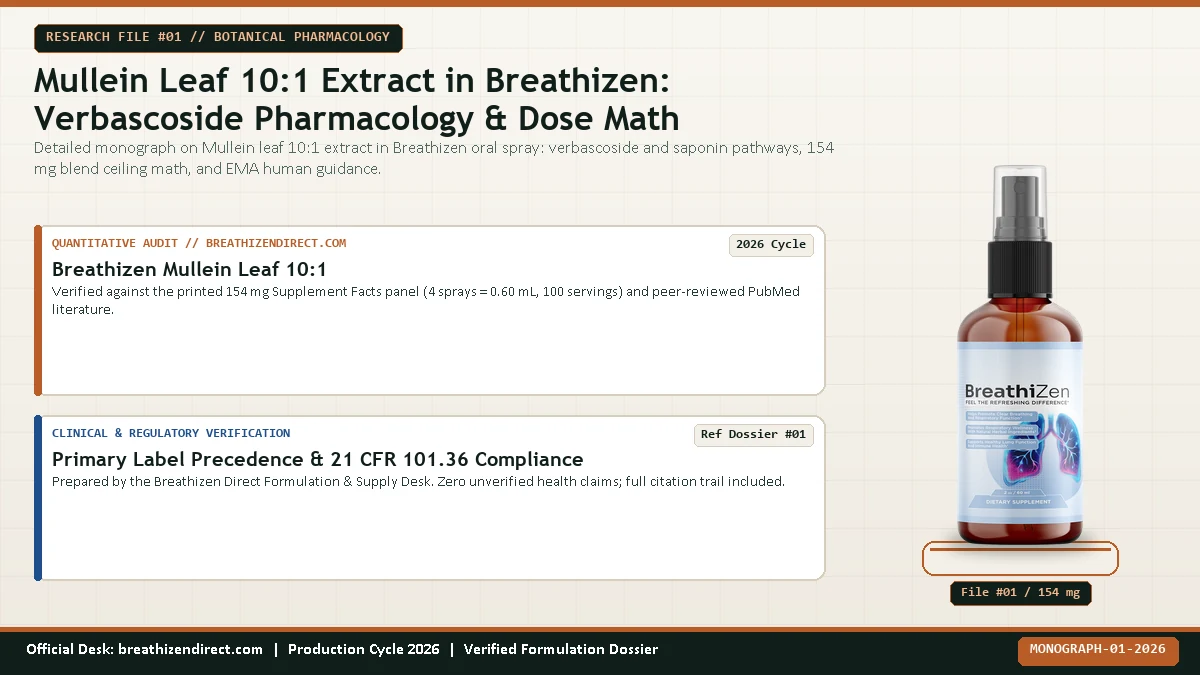
Mullein Leaf 10:1 Extract in Breathizen: Verbascoside Pharmacology & Dose Math
Mullein (Verbascum thapsus L.) leaf 10:1 extract occupies Position #1 inside Breathizen's 154 mg proprietary blend, which mathematically guarantees a per-serving dose between 51.33 mg and 152.0 mg of concentrated extract (equivalent to 513 mg to 1,520 mg of dried mullein leaf per 0.60 mL daily spray serving). Below is our complete pharmacological audit of its phenylethanoid glycoside (verbascoside), iridoid (aucubin, catalpol), saponin, and mucilage polysaccharide pathways compared against European Medicines Agency (EMA) human dosing monographs.
Monograph Dossier #01 (Botanical Pharmacology): Detailed monograph on Mullein leaf 10:1 extract in Breathizen spray: verbascoside and saponin pathways, 154 mg blend math, and EMA human guidance.Official Desk: breathizendirect.com · 1200x675 Widescreen Assay
1. Botanical Identity, 10:1 Extraction Ratio & Position #1 Blend Mathematics
Common mullein (Verbascum thapsus L., family Scrophulariaceae) is a biennial rosette-forming herb whose densely pubescent leaves and yellow corolla flowers have been documented in European and North American respiratory materia medica for more than two millennia (Turker & Gurel 2005, PMID 16222647; Turker & Camper 2002, PMID 12241986) [1][2]. On the physical Breathizen Supplement Facts panel distributed by GEX Corp, Lakeland, FL 33804, the first active ingredient listed inside the 154 mg Proprietary Blend is Mullein (Verbascum thapsus) (leaf) Extract 10:1.
Under FDA regulation 21 CFR 101.36(c) [50], listing Mullein leaf 10:1 extract first in a three-ingredient 154 mg blend establishes two strict mathematical boundaries:
Minimum Possible Dose per 0.60 mL (4-Spray) Serving: If all three extracts in the blend were present in equal proportions ($154 mg / 3$), Mullein leaf 10:1 extract would weigh exactly 51.33 mg. Because a 10:1 drug-to-extract ratio (DER) concentrates the water-soluble solids of 10 parts crude dried leaf into 1 part extract, 51.33 mg of 10:1 extract corresponds to the water-soluble fraction of 513.3 mg of dried mullein leaf.
Maximum Possible Dose per 0.60 mL (4-Spray) Serving: If Ginger root extract (Position #2) and Organic Lemon extract (Position #3) sit at a 1.0 mg trace floor each, Mullein leaf 10:1 extract reaches 152.0 mg, corresponding to 1,520 mg (1.52 g) of dried mullein leaf equivalent.
Realistic Formulation Midpoint (~95 mg Extract = ~950 mg Dried Leaf Equivalent): In standard commercial glycerite spray compounding, the lead botanical typically accounts for 58% to 65% of the blend mass (~90 to 100 mg of 10:1 extract per serving).
2. Four Phytochemical Families Inside Verbascum thapsus Leaf
Recent phytochemical reviews (Gupta et al. 2022, PMID 35088467; Blanco-Salas et al. 2021, PMID 34356473) [3][4] identify four primary secondary metabolite classes in aqueous-glycerin mullein leaf extracts that govern upper-airway and mucosal comfort:
Hydrophilic Mucilage Polysaccharides (~3% of Crude Leaf): High-molecular-weight acidic arabinogalactans, xyloglucans, and neutral glucans that hydrate in water and vegetable glycerin to form a viscoelastic hydrocolloid network. Because polysaccharide polymers (>50 kDa) cannot cross stratified buccal epithelium or intestinal tight junctions intact, their pharmacological action is 100% topical on the oropharyngeal mucosa - forming a soothing bioadhesive barrier over exposed vagal cough mechanoreceptors in the posterior pharynx [9][26].
Phenylethanoid Glycosides (Verbascoside / Acteoside): Verbascoside is a caffeoyl phenylethanoid glycoside shown in human THP-1 myelomonocytic cells (Speranza et al. 2010, PMID 20812283) [5] to downregulate nuclear factor kappa-B (NF-κB) nuclear translocation, inducible nitric oxide synthase (iNOS), and pro-inflammatory cytokine (TNF-α, IL-1β, IL-6) release.
Triterpenoid Saponins (Verbascosaponins A & B): Amphiphilic glycosides bearing both hydrophilic sugar chains and lipophilic oleanane aglycones. When swallowed into the stomach, saponins gently stimulate gastric vagal afferent fibers (the gastro-pulmonary mucokinetic reflex), encouraging serous bronchial glands to secrete thinner, less viscous hydration fluid into the respiratory tract [3][4].
Iridoid Glycosides (Aucubin, Catalpol, Harpagoside) & Flavonoids (Luteolin, Apigenin, Quercetin): Contribute local antioxidant radical scavenging across mucosal surfaces exposed to dry air or environmental particulates [1][3].
3. Clinical Evidence Audit vs. EMA HMPC Human Dosing Benchmarks
How does Breathizen's 513 mg to 1,520 mg dried-leaf equivalent per 0.60 mL daily serving compare against official European regulatory standards and published human trials? In its official European Union herbal monograph on Verbascum thapsus (EMA/HMPC/611531/2016) [9], the European Medicines Agency's Committee on Herbal Medicinal Products (HMPC) recognizes mullein for the relief of sore throat associated with dry cough and cold, specifying a traditional adult oral regimen of 1.5 g to 2.0 g of comminuted herbal substance as an infusion taken 3 to 4 times daily (4,500 mg to 8,000 mg/day total), or equivalent liquid extracts.
Notice the quantitative gap: a single 4-spray morning serving of Breathizen supplies roughly 11% to 33% of a single EMA cup of mullein infusion (and 6% to 25% of the full multi-cup EMA daily regimen). Furthermore, while published pediatric trials of mullein-containing naturopathic drops demonstrated statistically significant analgesia in acute otitis media (Sarrell et al. 2001 & 2003, PMID 11434846 & 12728112) [7][8] and methanolic mullein extracts inhibited viral replication in vitro (Escobar et al. 2012, PMID 21999656) [6], no randomized controlled human trial has ever demonstrated that 51 to 152 mg/day of oral mullein 10:1 extract improves spirometric lung volumes (FEV1 or FVC) in asthma or COPD.
One genuine formulation advantage of a filtered 10:1 liquid extract over loose-leaf mullein teas or raw herbal capsules involves plant anatomy: raw Verbascum thapsus leaves are covered in microscopic, branching star-shaped hairs (stellate trichomes). When consumers brew loose mullein tea without passing it through a fine paper coffee filter, suspended trichome hairs physically prickle the posterior pharynx and trigger paradoxical coughing. Because Breathizen uses a clarified 10:1 aqueous-glycerin extract filtered free of insoluble plant fibers, it delivers the water-soluble polysaccharides, verbascoside, and saponins with zero trichome mechanical irritation.
Parameter
Breathizen 1-Serving Spec (0.60 mL)
EMA HMPC Monograph Benchmark
Clinical & Mechanistic Verdict
Extract Mass Range (21 CFR 101.36)
51.33 mg (min) to 152.0 mg (max) of 10:1 leaf extract
Equivalent to 4,500 - 8,000 mg/day crude herb
Supplies ~11% to 33% of a single traditional tea cup; acts as a gentle daily micro-dose.
How much Mullein leaf extract is in 4 sprays of Breathizen?
Because Mullein leaf 10:1 extract is listed first in the 154 mg 3-ingredient proprietary blend, federal descending-weight rules (21 CFR 101.36) guarantee it weighs between 51.33 mg and 152.0 mg per 0.60 mL serving, equal to 513 to 1,520 mg of dried mullein leaf.
Does Mullein leaf extract contain irritating leaf hairs (trichomes)?
No. While raw dried mullein leaves are covered in microscopic stellate trichome hairs that can tickle the throat in unfiltered tea, Breathizen uses a clarified 10:1 liquid extract filtered free of insoluble plant hairs.
Can Mullein leaf 10:1 extract clear COPD mucus plugs or replace an inhaler?
No. Mullein leaf provides gentle pharyngeal demulcent soothing and mild saponin-mediated hydration support, but it cannot reverse airway remodeling, clear severe COPD mucus plugging, or replace prescribed bronchodilator and steroid inhalers.
Why does the label specify 'leaf' extract while the EMA monograph covers 'flower' (Verbasci flos)?
Both Verbascum thapsus leaf (folium) and flower (flos) contain mucilage polysaccharides, verbascoside, and saponins. Commercial North American liquid supplements favor leaf 10:1 extracts due to higher biomass stability and year-round harvesting consistency.
Is Mullein leaf 10:1 extract safe to take every morning for 90 days?
In healthy non-pregnant adults, 51 to 152 mg/day of aqueous-glycerin mullein leaf 10:1 extract has an excellent tolerability record with no known cytochrome P450 drug interactions or stimulant side effects.
Related Clinical Monographs in the Breathizen Research Cluster