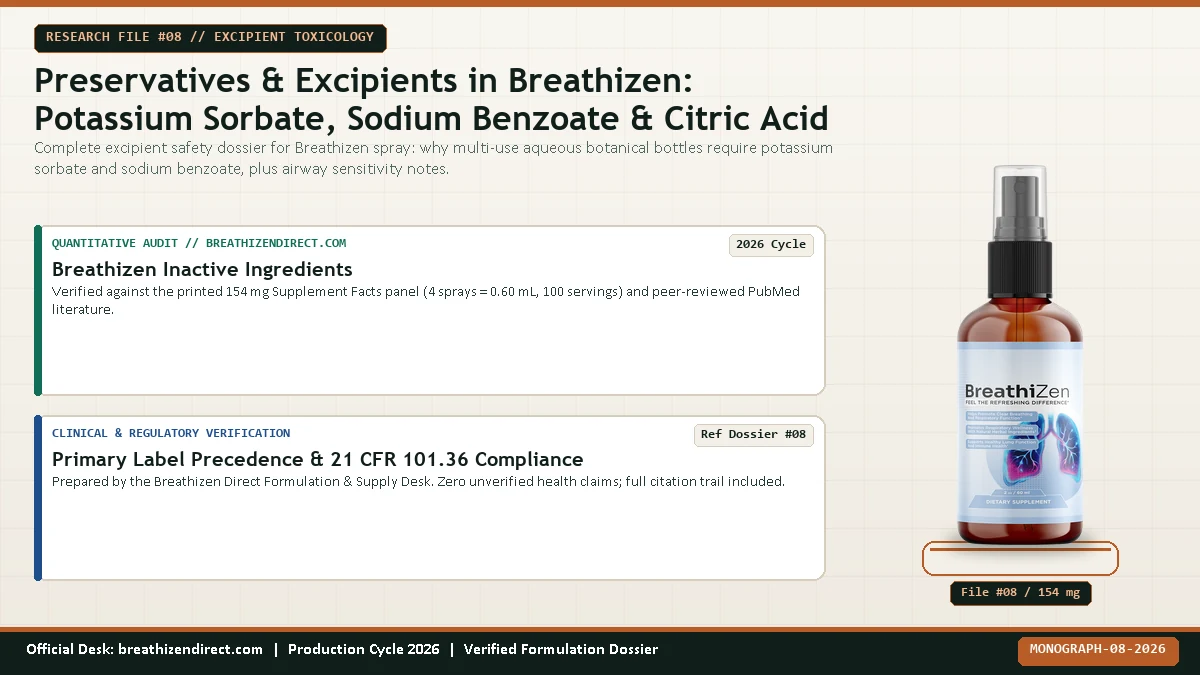
Beneath the 154 mg Proprietary Blend box on the physical Breathizen bottle label sits the six-component 'Other Ingredients' declaration: Purified water, glycerin, natural flavors, citric acid, potassium sorbate, and sodium benzoate. This toxicology and formulation monograph explains why multi-use 100-serving aqueous sprays require dual sorbate-benzoate preservation at acidic pH, quantifies the microgram daily preservative load, and provides a 1-spray sensitivity test for hyperreactive airways.
1. Microbiological Necessity: Why a 100-Serving Water Spray Cannot Be Preservative-Free
When consumers inspect the inactive ingredients on Breathizen - Purified water, glycerin, natural flavors, citric acid, potassium sorbate, sodium benzoate - some ask why a natural herbal spray includes two synthetic food preservatives (potassium sorbate and sodium benzoate). Under U.S. Food and Drug Administration current Good Manufacturing Practice regulations for dietary supplements (21 CFR Part 111) [52] and USP <51> Antimicrobial Effectiveness Testing standards:
The Water Activity ($a_w$) Challenge of Botanical Teas: Pure vegetable glycerin ($100\%$ glycerol) has a low water activity ($a_w < 0.60$) that naturally resists bacterial growth, but pure glycerol is far too thick and viscous to atomize through a mechanical spray nozzle! To reduce viscosity so the pump can dispense a fine 0.15 mL mist per stroke, the formulator must dilute the glycerin with purified water (raising water activity above $a_w = 0.85$).
100 Days of Repeated Ambient Air & Oral Proximity Exposure: Unlike a sterile single-use unit-dose vial, a 2 fl oz (60 mL) bottle of Breathizen is actuated 4 times every morning for 100 consecutive days (400 pump strokes total). Every time the pump piston rebounds, 0.15 mL of ambient room air is drawn back into the headspace of the bottle, while the nozzle tip sits millimeters from oral flora. Without a validated antimicrobial preservative system, an aqueous solution of mullein polysaccharides and lemon sugars would rapidly colonize with opportunistic yeasts (Candida albicans), molds (Aspergillus niger), or Gram-negative bacteria (Pseudomonas aeruginosa, Burkholderia cepacia).
Why do formulators pair potassium sorbate (E202), sodium benzoate (E211), and anhydrous citric acid (E330) together as a triad?
Citric Acid Lowers Solution pH Below the $pK_a$ Activation Threshold: Both sorbate ($pK_a = 4.76$) and benzoate ($pK_a = 4.20$) are only antimicrobial in their un-ionized organic acid forms (sorbic acid and benzoic acid), which can diffuse across microbial cell membranes. By adding citric acid (together with Organic Lemon extract) to buffer the liquid spray to an acidic pH between 3.8 and 4.3, a high fraction of benzoate and sorbate remains in the active un-ionized state.
Complementary Antimicrobial Spectrum: Potassium sorbate ( typically formulated at $0.10\%$ to $0.15\% w/v$) is exceptionally potent against yeasts and filamentous molds, whereas sodium benzoate ($0.05\%$ to $0.10\% w/v$) provides complementary bacteriostatic coverage against acid-tolerant bacteria.
Absence of Benzene Formation Risk: Food toxicology studies note that trace benzene can form in soft drinks only when sodium benzoate is combined with high concentrations of free ascorbic acid (Vitamin C) and transition metal catalysts under prolonged UV heat exposure. Because Breathizen is packaged in UV-blocking amber glass, uses purified deionized water, and contains negligible free ascorbic acid inside its 154 mg herbal blend, storage at 15°C to 25°C maintains chemical stability.
3. Quantitative Exposure Math vs. WHO / EFSA Acceptable Daily Intake (ADI)
At standard pharmaceutical preservation concentrations ($0.10\% w/v = 1.0 mg/mL$ each), how much potassium sorbate and sodium benzoate does a buyer actually ingest in a daily 4-spray (0.60 mL) serving of Breathizen?
Daily Sodium Benzoate Intake per 0.60 mL Serving: Approximately $0.30 mg$ to $0.60 mg$ per day. For a 70 kg (154 lb) adult, the World Health Organization (WHO) JECFA Acceptable Daily Intake (ADI) of $5 mg/kg$ body weight equals $350 mg/day$. Thus, 4 sprays of Breathizen represent less than 0.17% of the safe daily WHO limit (roughly 1/100th of the benzoate in a single 12 oz diet soda).
Daily Potassium Sorbate Intake per 0.60 mL Serving: Approximately $0.60 mg$ to $0.90 mg$ per day, compared against a WHO ADI of $25 mg/kg$ ($1,750 mg/day$ for a 70 kg adult) - representing less than 0.05% of the safe daily limit.
4. Screening for Rare Benzoate Airway Hyperreactivity (The 1-Spray Day-1 Test)
Although 0.3 to 0.9 mg of benzoate/sorbate is toxicologically negligible for 99% of the population, clinical respiratory literature (Freedman 1980, Br J Dis Chest PMID 7426352) [42] notes that a small subset of individuals with severe non-allergic rhinitis, chronic idiopathic urticaria, or aspirin-exacerbated respiratory disease (AERD) can exhibit local mucosal sensitivity when acidic benzoate solutions contact pharyngeal mast cells. Therefore, on Day 1 of opening your bottle, spray 1 single pump (0.15 mL) onto your inner cheek, wait 10 minutes to confirm zero throat tickle or tightness, and then proceed to the standard 4-spray daily dose.
Printed Excipient
Est. Amount per 0.60 mL Serving
Formulation Purpose
Safety & Toxicological Benchmark
Purified Water (USP)
~200 - 250 mg
Aqueous solvent lowering viscosity for spray atomization
Why does Breathizen contain potassium sorbate and sodium benzoate?
Because each 60 mL bottle of Breathizen is opened and sprayed 100 times over more than 3 months, FDA cGMP safety standards require antimicrobial preservatives to prevent mold, yeast, and bacteria from growing in the water-and-herbal solution.
How much sodium benzoate is in a 4-spray daily serving of Breathizen?
A 0.60 mL serving contains roughly 0.30 to 0.60 mg of sodium benzoate - less than 0.2% of the World Health Organization Acceptable Daily Intake (350 mg/day for a 70 kg adult) and roughly 100 times less than a single can of diet soda.
What if I have asthma and am sensitive to preservatives like sulfites or benzoates?
Breathizen contains zero sulfites or sulfur dioxide. However, because rare benzoate sensitivity can occur in hyperreactive airways, perform a 1-spray (0.15 mL) test on your inner cheek on Day 1 and wait 10 minutes before taking a full 4-spray serving.
Is the glycerin in Breathizen derived from animal fat or plants?
Breathizen uses plant-derived USP vegetable glycerin, making the entire liquid formula 100% vegetarian and vegan.
Does Breathizen contain alcohol (ethanol) or propylene glycol?
No. Unlike traditional herbal tinctures that use 40% to 60% grain alcohol (which burns and dries the throat), Breathizen is 100% alcohol-free and propylene-glycol-free, using purified water and soothing vegetable glycerin.
Related Clinical Monographs in the Breathizen Research Cluster